

Tchaikovsky’s Symphony No. 5
When we listen to the inventive, magically melodic and infectious music of Pyotr Ilych Tchaikovsky, it’s hard to imagine that the composer was plagued with doubt about his talents throughout his all-too-short life, often swinging wildly between pride in his work and a conviction that his creative powers were failing.
His Symphony No. 5 is a prime example of the disconnect between the composer’s often brutal self-assessments and the prevailing opinion of the rest of the musical world. It was composed between May and August 1888, 11 years after his Fourth Symphony, and it has long been celebrated as one of his finest orchestral works, cementing his legacy and popularity. Yet before he even started working on it, Tchaikovsky was almost overcome by fears that he was bereft of ideas. In letters to his patron, Nadezhda von Meck, the composer confessed that the urge to create had deserted him and he had “no ideas or inspiration whatsoever … Am I indeed, as they say, written out?”
Perhaps his negative feelings about that work were related to the issues that motivated it. We know that this symphony embodies Tchaikovsky’s struggle with fate and his personal demons. Although he insisted that the work was not programmatic, several cryptic entries in his notes describe the first movement as “complete resignation before fate” and include “reproaches against XXX.” Musicologists believe “XXX” may have been a code for his hidden homosexuality or other personal anxieties.
After conducting the premiere in St. Petersburg in November 1888, Tchaikovsky considered the symphony unsuccessful, calling it “repellent” and “insincere.” Following the second performance, Tchaikovsky wrote, “I have come to the conclusion that it is a failure.” It wasn’t until a subsequent performance in Hamburg in 1889 that the composer wrote that he “started to love it again.” The enthusiasm of the musicians and the audience led him to conclude that his earlier judgment had been “undeservedly harsh.”
The work is unified by a recurring “Fate” motif introduced by the clarinets. This theme transforms throughout the symphony: starting as a dark, funereal march in E minor and ending as a triumphant, major-key celebration in the finale.
The second movement features one of the most famous horn solos in classical music. This luscious and romantic melody was so popular it was later adapted into the pop song “Moon Love,” recorded by artists like Glenn Miller and Frank Sinatra.
Instead of a traditional lively scherzo for the third movement, Tchaikovsky composed an elegant waltz, a nod to his mastery of ballet music. It contains one of the composer’s most memorable melodies.
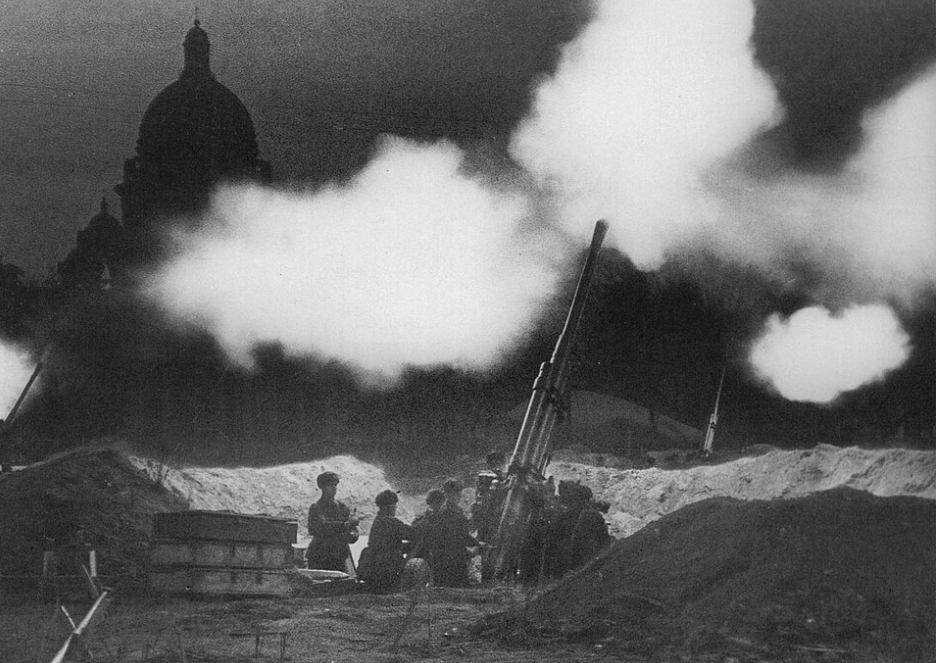
The symphony’s theme of ultimate victory through strife made it very popular in times of conflict in Russia, particularly during World War II. Leningrad Radio Orchestra gave one of the most famous performances of the work during the Siege of Leningrad. City leaders had ordered the orchestra to continue its performances as a way to lift sagging spirits in the war-torn city.
On the evening of October 20, 1941 they performed it at the city’s Philharmonic Hall and it was broadcast live in London. As the second movement began, bombs started to fall nearby, which listeners in London could hear clearly. Undaunted, the musicians continued playing until the final, triumphant chord.
See Pacific Symphony perform Tchaikovsky’s Fifth Symphony May 7-9, 2026. Get tickets.
FACTS
- The recurring “Fate” motif that appears in all four movements comes from a passage in Mikhail Glinka’s 1836 opera “A Life for the Tsar.” Specifically, the melody is associated with the phrase “turn not into sorrow” in the opera.
- Johannes Brahms, who famously disliked Tchaikovsky’s music (and vice versa), stayed an extra day in Hamburg just to hear the Fifth Symphony. While the two composers shared a friendly lunch and drinks, Brahms told Tchaikovsky he “didn’t like the Finale”—a sentiment Tchaikovsky actually agreed with at the time.
- The famous, soulful horn solo from the Andante cantabile was adapted into the popular 1939 song “Moon Love.” It has also been cited as a likely (though perhaps unconscious) inspiration for the opening melody of John Denver’s “Annie’s Song.”
- Tchaikovsky dedicated the symphony to Theodor Avé-Lallemant, a German teacher and director in Hamburg. He actually disliked Tchaikovsky’s modern style and once advised him to stay in Germany to “correct” his Russian defects through more traditional study. Tchaikovsky, surprisingly touched by the elderly man’s sincerity, dedicated the work to him despite their creative differences.
- After its American debut, critics were notoriously harsh. One reviewer for the Boston Evening Transcript described the finale as “a horde of demons struggling in a torrent of brandy, the music growing drunker and drunker,” while a New York scribe called it a “slaughter, dire and bloody.”
- In the original manuscript for the second movement, Tchaikovsky wrote the French words “O, que je t’aime! O mon amie!” (“Oh, how I love you! Oh my friend!”) above the famous horn solo. While he never specified who this “friend” was, it adds a layer of deeply personal intimacy to one of the most romantic melodies ever written.
Pictured in this blog:
Header image: Pyotr Ilyich Tchaikovsky (1887)
Body image: The fire of anti-aircraft guns deployed in the neighborhood of St. Isaac’s cathedral during the defense of Leningrad (now called St. Petersburg, its pre-Soviet name) in 1941.