
Berlioz tells it like it is.
You take a drug trip, you wind up screaming at your own funeral.
The life of French composer Hector Berlioz encompassed contradictory extremes. He was a perceptive critic and writer who championed younger composers such as Charles Gounod. As an advocate for music, especially French music, he let logic be his guide. But his personal life was wildly passionate and reckless, and his Symphonie Fantastique is a product of his passions—an expression not only of his burning infatuation with a seemingly unattainable woman, but also of opium-induced fantasies.

Borne out by those who knew him, Berlioz’s account of the night in 1827 when he attended a Shakespearean performance in Paris shows him helplessly in the grip of overwhelming experience. He found himself on his knees, almost unable to breathe, consumed by the power of the acting and the sound of Shakespeare’s language. He did not understand a word of it, but it became an obsession—as did Miss Smithson, the actress whom he pursued for years and eventually married. “The impression her outstanding talent made on my mind is only comparable to the upset which I suffered from the poet whose worthy interpreter she was,” he later wrote.
Berlioz wrote numerous love letters to the charismatic Irish actress when she was in Paris, but they went unanswered, and she left that city without having met him. He composed the Symphonie Fantastique as a declaration of love, but it is also an expression of frantic despair in which he envisions his own death. Few works of art have so successfully and vividly captured feelings so fevered that they seem to embody the paradigm of the American beat poets of the 1950s: life lived at a pitch that was next to madness. And like many of the beat poets, Berlioz was more than likely under the influence of his drug of choice—opium—when he composed much of the Symphonie Fantastique. Leonard Bernstein put it bluntly and brilliantly when he observed, “Berlioz tells it like it is. You take a [drug] trip, you wind up screaming at your own funeral.”
When Harriet Smithson finally heard the Symphonie Fantastique in performance, in 1832, she glimpsed the extent of his genius—and his passion. Six years after he had first seen her on stage, Berlioz succeeded in making her his wife, though they did not share a common language. (Perhaps few husbands and wives actually do.) Their marriage was a disaster.
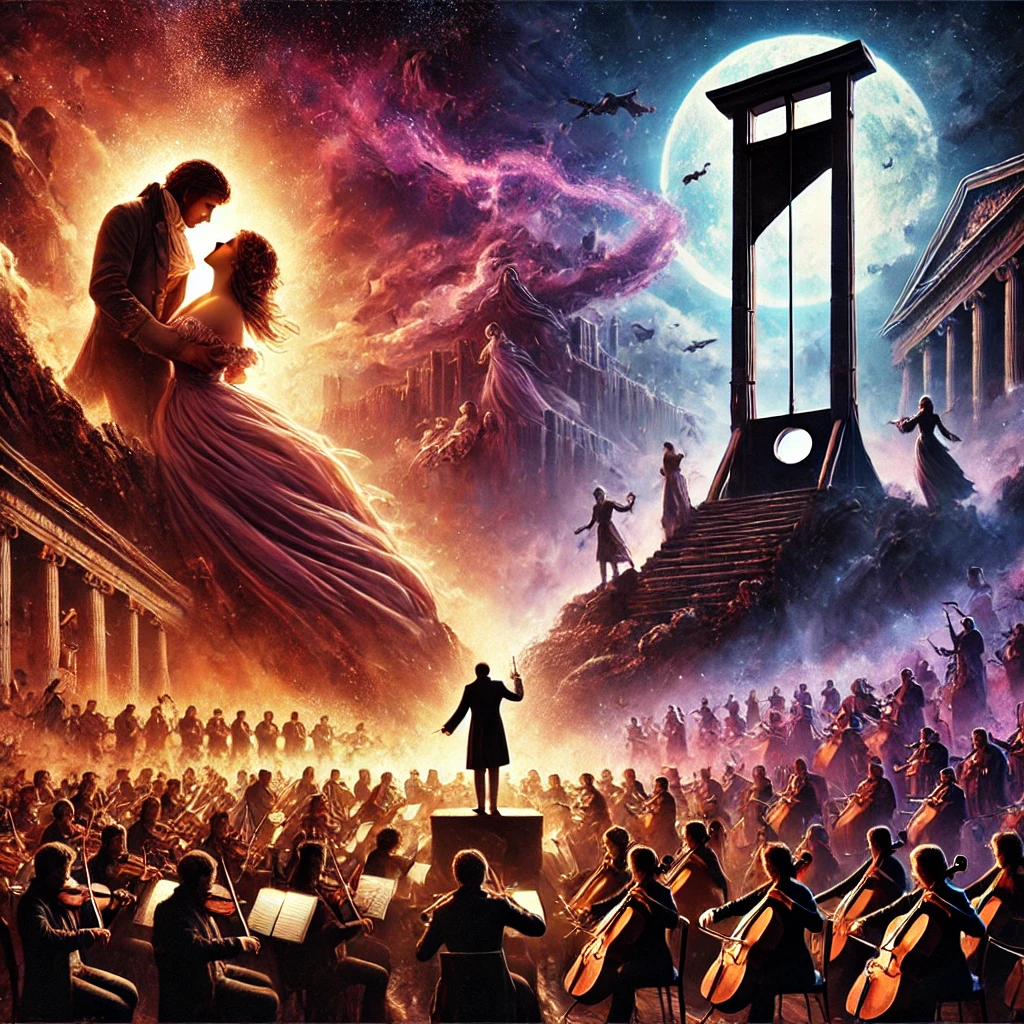
Yes, Berlioz’s life embodied the clichés of flaming Romanticism. But our impressions of him as a firebrand spring not only from his eventful love life, but from his visionary music, which was early in its use of modern, overlapping rhythms and surprising harmonies. Perhaps most important of all, Berlioz found ways to make orchestral music brilliantly dramatic, seeming to delineate incidents without words. Wagner shared Berlioz’s concern with the relationship of music to drama, and we can hear traces of this symphony in Tristan und Isolde, which came to the public 20 years later.
Berlioz’s spirit of innovation came at a crucial time for the symphony. Anyone who attempted the form after 1827 did so in the shadow of Beethoven, who had redefined the possibilities of symphonic form with his Choral Symphony, the Ninth. Through the end of the 19th century, most Germanic composers were still incorporating the familiar, decorative conventions of the late Romantic era in their symphonies—Dvořák, Saint-Saëns, Brahms, and Tchaikovsky, to name a few. Though Brahms was also haunted by the specter of Beethoven, he worked as an apprentice might with a master’s tools and traditions. Berlioz wrote the Symphonie Fantastique in 1830, just three years after Beehoven’s death. Though the symphonic stakes were not quite so high in France, the desire for new formal directions was still to be reckoned with.
Berlioz met this challenge with symphonies that were programmatic in nature, providing a story line that sometimes eclipsed the usual architecture of sonata allegro form. Though the technical elements of thematic introduction and exposition are still present, we are more compelled by drama than by form as we listen; the result is a symphony perched on the edge of the more freewheeling tone-poem. The Symphonie Fantastique is perhaps the single most famous example of a programmatic symphony, with its story line providing a way to push beyond historic boundaries of symphonic form.
To this day, the Symphonie Fantastique retains its power to shock, and no moment is more shocking than Berlioz’s introduction of the sacred melody of the Dies irae distorted into the eerie profanity of a witches’ dance. A final wisp of the beloved idée fixe is snuffed forever amid the corruption, a sublime motif twisted into a vulgar jig—a sad outcome rendered into glorious music.
Don’t miss Pacific Symphony’s Classical Spooktacular, Oct. 17-19 at the Renée & Henry Segerstrom Concert Hall! Carl St.Clair conducts.
Here a brief video from a few years ago:
Michael Clive is a cultural reporter living in the Litchfield Hills of Connecticut. He is program annotator for Pacific Symphony and has written numerous articles for magazines and newspapers in the U.S. and U.K. and hundreds of program notes for orchestras and opera companies. Learn more at Operahound.com.