
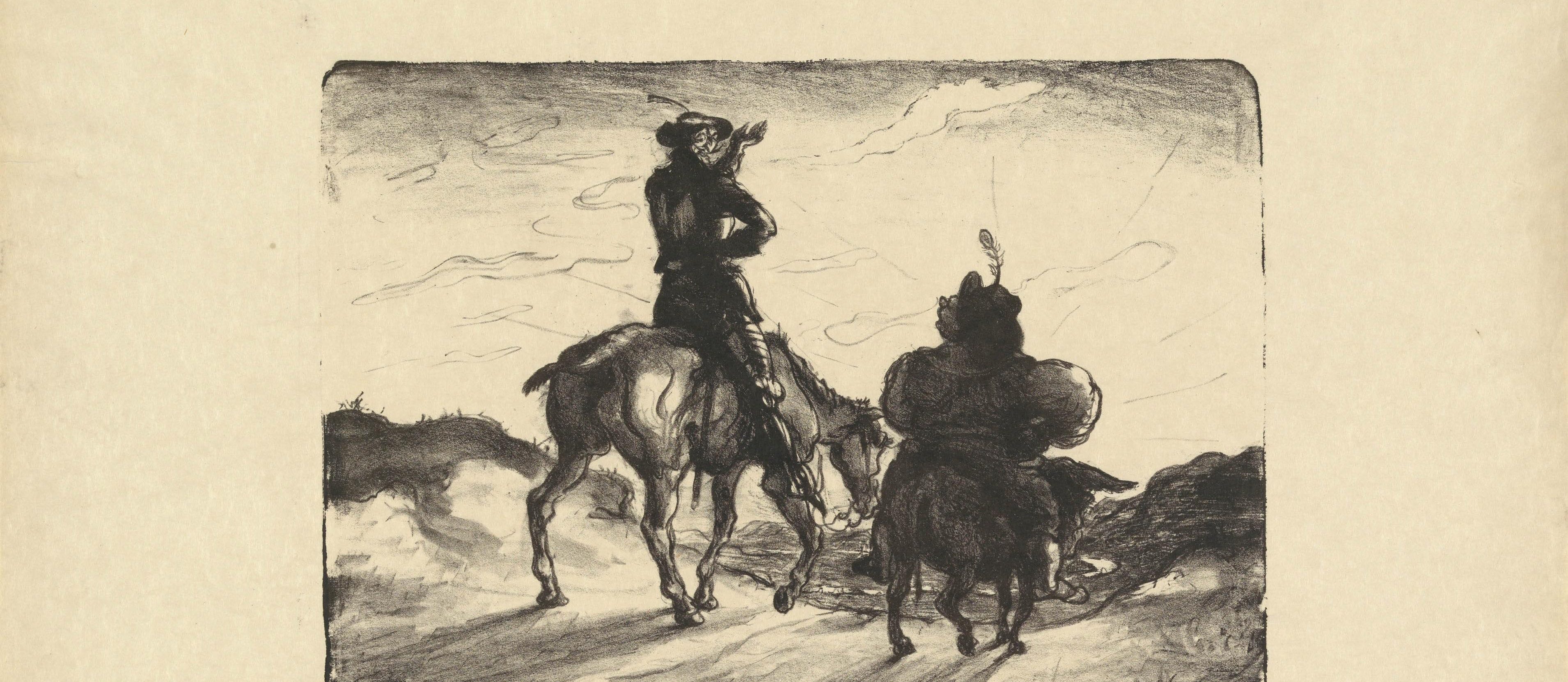
“In short, he became so absorbed in his books that he spent his nights from sunset to sunrise, and his days from dawn to dark, poring over them; and what with little sleep and much reading his brains got so dry that he lost his wits.” – Cervantes
So we learn from the first chapter of Cervantes’ Don Quixote that our central character has gone crazy from reading too much. Specifically, from reading books about the age of chivalry. Longing to live in a world of honor, nobility and courage rather than the decidedly unchivalrous world he’s stuck in, our Don begins to hallucinate. A day laborer becomes a squire, windmills become giants, and through his bout of insanity, Quixote’s quotidian life becomes a majestic quest for glory, a fight against implacable evil, and a blind adoration of his flawless and unattainable woman.
The fact that no glory is to be had, that the evils he fights are all in his fevered imagination, and that his “ideal” woman is a stable girl (to be generous) is beside the point. The point is, as lyricist Joe Darion puts it in “The Impossible Dream”: “to strive with his last ounce of courage/to reach the unreachable star!” Unbeatable foes? Unbearable sorrows? Unrightable wrongs? Bring it on.
Is Quixote delusional? Absolutely. And he pays a steep price for his delusions, over and over. Beatings, broken ribs, lost teeth, ridicule, humiliation. He’s not called the “Knight of the Sorrowful Countenance” for nothing. It’s Cervantes’ brilliance, though, that uses Quixote to show us the enormous gulf between the world we live in and the world we’d like to live in. Maybe too much reading hasn’t driven us all crazy, but who wouldn’t like to live a nobler and more adventurous life? The occasional broken rib would be a small price to pay.
And it’s Richard Strauss’s brilliance that saw Cervantes’ interplay between the real and the unreal, between the manners of an ancient court and the less mannered world of sheep on a Spanish hillside, as an ideal subject for his seventh tone poem Don Quixote (Fantastic Variations on a Theme of Knightly Character).
Cervantes’ vibrant imagery and vivid characterizations give Strauss plenty of rich material. Quixote himself is “played” by a cello: lugubrious and aristocratic. His companion Sancho Panza’s theme—first in the hands of the bass clarinet and tenor tuba, later depicted by solo viola—is simpler, a voice of common sense. The two together show us the novel’s central conflict: idealism and the wet blanket thrown over it.
And while these themes and their musical expressions march into thorny territory, of madness, resignation, psychological harm, and the world’s predictable cruelty, Quixote is a comic figure, the novel is laugh out loud funny, and Strauss’ composition has some of the greatest examples of musical humor in the canon.
Quixote galloping face first into a windmill in Variation I. Or Variation II, “The victorious struggle against the army of the great emperor Alifanfaron,” in which our hero charges valiantly into a heralded and triumphant battle against the previously mentioned sheep. Quixote’s fearless gallantry crashing into the mild, dim, bleating animals? It’s high comedy.
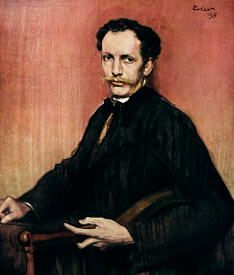
Thus it’s with sadness that the story comes to an end with Quixote returning to his right mind. Reality has won out after all, curse it. And almost immediately after sacrificing his quest, Quixote dies. His illusions sustained him, created meaning for him. Without them—without adventure, without a noble cause—what makes life worth living?
Strauss marks the final movement of his tone poem “Sehr ruhig”: very calm, peaceful, and quiet. In doing so, he is extending kindness to Quixote and to us, giving a benediction of dignity and reassurance. His madnesses have made the world a better place. He’s earned his peace.
Fast facts
- Don Quixote is considered the first modern novel: Cervantes published it in 1605.
- Strauss thought the music spoke for itself and didn’t need explanation. His response when asked for notes: “Get out! You don’t need any.”
- Of the ten tone poems Strauss wrote, he considered Quixote one of his top three favorites, along with Thus Sprach Zarathustra and Symphonia Domestica.
- Cervantes lost the use of his left arm at the Battle of Lepanto in 1571. As a writer, he claimed he’d “lost the movement of the left hand for the glory of the right”.
- In 1575, Cervantes was captured by pirates and spent five years in captivity as a slave. He attempted to escape four times and was finally rescued by a religious charity that specialized in ransoming Christian captives.
- Don Quixote has been adapted and re-interpreted many times, not just as the Broadway hit Man of La Mancha, but also including: Terry Gilliam’s The Man Who Killed Don Quixote (2018) starring Jonathan Pryce and Adam Driver; Don Quixote (2000) a television adaptation featuring John Lithgow and Bob Hoskins, and Quichotte (2019) Salman Rushdie’s novel setting the story in contemporary America.
See Carl St.Clair conduct Strauss’ Don Quixote February 5-7, 2026. Get tickets here.


Leave a Reply