

Was there a greater transformation in music than the one that took place over the 63 years of Brahms’ lifetime? He was born just after Beethoven’s death into a world dominated by Liszt, Chopin and Schumann; Early Romantics mapping the first excursions into the space between classical forms and personal expression. By the time Brahms died in 1897, music history had welcomed Sergei Prokofiev, Paul Hindemith, Jelly Roll Morton and Irving Berlin into the world. Ragtime was in its ascendancy, and the music of George Gershwin, Duke Ellington, and Arnold Schoenberg was just around the corner.
Safe to say that Brahms (irritable, foul-tempered Brahms) did not approve of the direction the art form was headed during his lifetime, and had he lived longer he would have hated where we are even more.
For him, Liszt and Wagner were “new music” and he despised it. In the midst of one revolution after another, he aligned himself with past masters. With Haydn and Mozart. There’s profound emotional content in his works, but it’s grounded in classical forms and techniques. He was the “keeper of the flame,” a reluctant romantic looking back longingly at the Classical era.
And if there’s one work that epitomizes his mastery of traditional forms as expressed through his immediately identifiable voice, it’s his Symphony No. 4 in E minor. In structure and form it is his most Classical symphony while at the same time his most unrelentingly bleak.
Musicologist Julius Harrison puts it this way:
“Because [Symphony No.4] is so austere, so uncompromising, so unprogrammatic, those compelled to describe it are at a loss. We are thrown back on its absolute worth and find ourselves with insufficient words to describe it. In the first movement, the music develops from the first note to the last with scarcely a pause for breath anywhere and with a technique so unerring that we can almost imagine it in one long drawn-out phrase wherein subjects, episodes, counterpoints, harmonies and orchestration all merge into one fusion of elements. A veritable commonwealth of music’s finest attributes.”
Certainly this speaks to the composer’s authoritative craftsmanship; in popular parlance, the “left-brained” logical, analytical side. As for the “right-brained” emotional content, the symphony is saturated with loss and yearning, with foreboding and tragedy.
Written in the Alps in bucolic splendor, and at the peak of Brahms’ fame and success, the work is one of the most bleak and unforgiving in the repertoire.
His three previous symphonies, while expressing their own darker and melancholic moods, resolve in the major at the conclusion. The listener may go through a harrowing voyage, but at the end, EGBOK: Everything is Going to Be Okay.
Not here. The fourth’s final movement starts grim and ends grimmer. No respite, no happy conclusion. Endless winter. Sir Donald Tovey describes it this way: “The hero is not fighting for his happiness. He is to die fighting.”
Why such darkness has been a source of endless speculation. Some point to the fact that Brahms was reading Sophocles’ tragedies at the time, some to Brahms’ despair at the culture’s ruination of the craft he had spent his life perfecting, some to his typical brooding nature. (While composing the symphony, Brahms wrote to his publisher telling him what to do with the score in case “the most human thing should happen to me” before the premiere.) No definitive answer is forthcoming.
From the orchestral premiere, critical reception has been uniformly awe-struck. “Nothing since Beethoven has approached the immensity of this symphony,” said Harrison. “Probably nothing ever will, even to the end of time.” In our own time, Jan Swafford says the finale is “his most remarkable symphonic movement, most profound in craftsmanship, most wide-ranging in historical resonances, and most troubling” and that the symphony as a whole is “a technical tour de force in an archaic genre, expressed in terms of a personal and cultural tragedy.” Conductor Felix Weingartner said, “I cannot get away from the impression of an inexorable fate implacably driving some great creation, whether of an individual or a whole race, toward its downfall….[The finale is] a veritable orgy of destruction, a terrible counterpart to the paroxysm of joy at the end of Beethoven’s last symphony.”
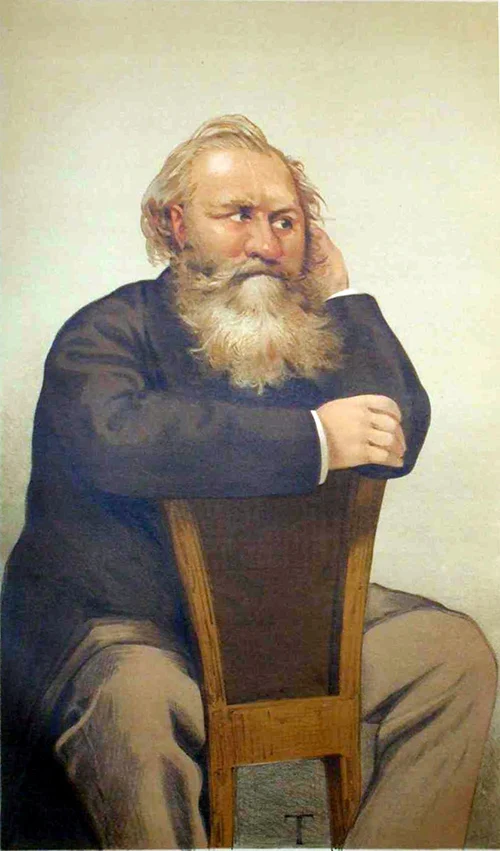
Nothing of this quality comes easy, though. Brahms began composing in 1884 and was coy (self-protective?) about his efforts. In summer 1885, a friend asked him what he’d been working on. “A new string quartet, perhaps?” “God forbid, nothing so grand as that,” said Brahms. “I’ve just thrown together a bunch of polkas and waltzes.”
Soon after, he was ready to present movements of the work in two-piano arrangement for a select few, including the critic Eduard Hanslick. It didn’t go well. Following the first
movement, Hanslick said “I feel like I’ve just been beaten up by two terribly intelligent people.”
“It’s very doubtful I will inflict the piece on anyone else,” he later wrote to his confidante Elizabeth von Herzogenberg. To his publisher Fritz Simrock he wrote, “I haven’t the ghost of an idea whether I’ll let the thing be printed. You’d be insane to invest a groschen in it.”
Brahms remained anxious about its reception right until the premiere, under his own baton, on October 25, 1885. The symphony was met with instant acclaim and has been fixed in the canon ever since.
SIX FAST FACTS
- Brahms was highly self-critical, and burned more work than he kept. What we have is a fraction of what he composed
- He was an autograph manuscript hound, boasting a collection of original scores by Bach, Mozart and Beethoven among many.
- He was famously brusque. Following a performance by a string quartet, one of the quartet members asked if Brahms liked the tempos. “Yes,” said Brahms. “Especially yours.”
- Despite Brahms’ public feud with Wagner, he studied Wagner’s work and they exchanged letters. Wagner once sent Brahms a score of Das Rheingold, to which Brahms wrote back: “What you have sent gives me so much pleasure that I cannot abstain from telling you…my deep gratitude for the splendid present.”
- Brahms never married, saying “It would be as difficult for me to marry as to write an opera.”
- As a young, unknown composer Brahms was invited to a performance by Franz Liszt at the great pianist’s home. During the performance, he fell asleep.

Leave a Reply