
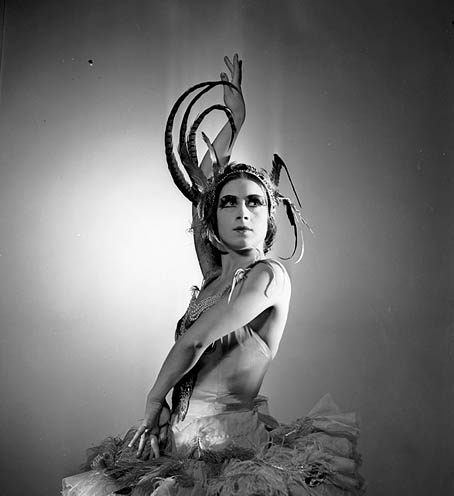
Enter the world of fairy tales and you’ll find yourself surrounded by rules. Don’t lie or no one will believe you when you tell the truth. Don’t tell someone you can spin straw into gold when you can’t. And if you’re going to seek a princess for a bride, prepare to face down some sort of monster. (That said, it’s well known that princesses can slay dragons on their own, without any help, thank you very much).
We see that last trope in stories and legends like Sleeping Beauty, Snow White, Rapunzel, and St. George and the Dragon, among many others. We also see it front and center in the Slavic tale of The Firebird.
To be fair, there are many Firebird stories. Variations of persona and plot abound. But the most well-known version today is the one fashioned by choreographer Michel Fokine and theater designer Alexandre Benois for the ballet produced by Sergei Diaghilev’s Ballets Russes in 1910.
Here, a sinister ogre/sorcerer, Kashchei the Deathless, has been capturing princesses and imprisoning them in his enchanted realm, and turning their would-be rescuers into stone statues.
The Czar’s son Prince Ivan is on a hunting trip and wanders into Kashchei’s enchanted garden, where he captures the magical Firebird, a creature of immeasurably beautiful flame-like plumage. The bird cries for mercy, and the noble prince grants it, but as he sets her free, he takes a boon, one of her feathers, which he can use to call on her for help in dire need.
While there he meets a princess, named Unearthly Beauty, and the two fall in love. She tells him of the princesses’ captivity and when the sorcerer summons the princesses back into his castle, Ivan follows. Now exposed, he’s captured by Kashchei’s monsters and is brought before the sorcerer. Just as he’s about to be turned to stone, he calls on the magic feather; the firebird forces Kashchei and his creatures to dance to exhaustion. They fall asleep, and the firebird shows Ivan an enormous egg in which Kashchei’s soul is preserved. Ivan breaks the egg, the sorcerer is killed, the statues come back to life, the princesses are freed, and Ivan and Unearthly Beauty announce their wedding.
A vivid story, awash with images of enchanted gardens, beautiful princesses, horrible monsters, and a radiant magical bird at the center. Imagery any composer would love to score. Except with the possible exception of Stravinsky, ironically.
“The Firebird did not attract me as a subject,” he said. “Like all ‘story’ ballets, it demanded ‘descriptive’ music of a kind I did not want to write.”
Famously, Stravinsky didn’t believe music was meant to be programmatic. He summed up his attitude to the presence of sentiment, feelings, emotion, and storytelling in music in his 1930 autobiography: “Music is by its very nature powerless to express anything at all.” For him, music was to be an abstract art, organized sound, a job for an architect.
That didn’t stop him from taking the commission, though. And from its first performance, at the Opera de Paris on June 25, 1910, it was a triumph. He was catapulted to a stratospheric level of fame, suddenly finding himself keeping company with the likes of Marcel Proust, Sarah Bernhardt, Jean Cocteau, and Maurice Ravel. Of the score, no less than Sergei Rachmaninoff said: “Great God! What a work of genius this is! This is true Russia!”
And for the rest of his life Stravinsky held a love-hate relationship with his early work. He bemoaned the “wastefully large” orchestra he used, the antiquated techniques he derived from Rimsky-Korsakov, the “embarrassing” recitative sections, its Romanticism in a neoclassic world. And yet he conducted it more than a thousand times, and it was the last piece he recorded.
SIX FAST FACTS
The Firebird launched a partnership with impresario Sergei Diaghilev that led in short order to Petrushka (1911) and The Rite of Spring (1913), arguably Stravinsky’s three best known and most popular works.

Stravinsky tinkered with the score for decades, producing three separate concert suites derived from The Firebird, in 1911, 1919, and 1945. Diaghilev originally engaged Anatoly Lyadov to score the ballet, but the notoriously slow-working Lyadov missed enough deadlines to compel Diaghilev to look elsewhere.
Stravinsky was only 27 when he wrote The Firebird and was 85 when he conducted it for his final recording: nearly 60 years with the work.
Diaghilev’s drive to stage The Firebird came from the Nationalist fervor of the time: “I need a ballet and a Russian one – the first Russian ballet, since there is no such thing – there is Russian opera, Russian symphony, Russian song, Russian dance, Russian rhythm – but no Russian ballet.” The Slavic folktale fit the bill.
As the well-attested story goes, Stravinsky dropped in to the jazz club Birdland in 1951 to hear Charlie Parker. Parker, seeing him in the audience, quoted the opening theme of The Firebird while playing the bebop tune “Ko-Ko.” Stravinsky was so pleased and astonished he pounded his glass on the table, spraying the guests behind him with scotch.
See Alexander Shelley conduct Stravinsky’s The Firebird January 15-17, 2026 at 8pm or January 18, 2026 at 3pm. Learn more.
Leave a Reply