
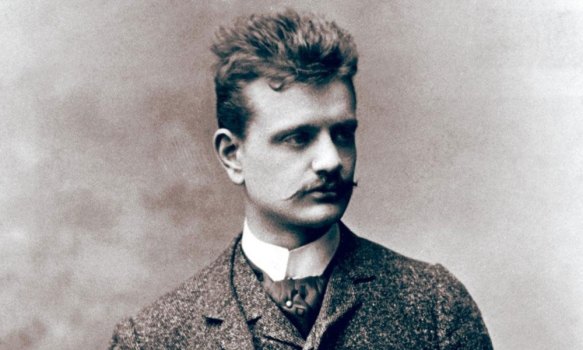
Sibelius’ First: Inner Turmoil and Romantic Sensibility
SIBELIUS: Symphony No. 1 in E minor, Op. 39
Sibelius, like Brahms, waited to finish his first symphony. His career was well underway when he tackled the challenge in his early 30s. And, like Brahms, he paid attention to the work of his contemporaries. His touchstone was Tchaikovsky. In 1894 and 1897, Tchaikovsky’s Pathétique Symphony was performed in Helsinki, and Sibelius was moved and intrigued by it. He wrote to his wife, “There is much in that man that I recognize in myself.”
Composed between 1898 and 1899, and revised in 1900, the First Symphony is a landmark work. It’s graced by extended melodies, dramatic contrasts and powerful orchestration, particularly for strings and woodwinds, and it’s divided into four movements, each with distinct personalities.
The creation of the First Symphony came at a watershed moment for Sibelius. He was a young husband and father, and like many emerging artists, he endured financial difficulties. The Finnish government, recognizing his talent, awarded him a small life pension in 1897, which provided some stability and allowed him to focus on composition.
But Sibelius had a taste for life’s extravagances and a growing dependence on alcohol, which complicated his life and work. His inner turmoil and romantic sensibility can be heard in the music, which ranges from passages of intense passion and heroism to moments of deep introspection and melancholy.
While the symphony is often compared to the works of Russian late-Romantic composers, particularly Tchaikovsky, there’s no denying that it’s the moment where Sibelius’s own distinct musical personality really asserts itself. From the very opening, a long clarinet solo over a soft timpani roll, the symphony announces a new and original voice. This was an unconventional way to start a symphony at the time, and it immediately sets a tone of lonely, untamed nature.
The work’s themes are developed naturally and organically, a technique Sibelius would master in his later symphonies. Melodic fragments are introduced and then gradually grow and transform, creating a sense of continuous, evolving narrative. The orchestration is brimming with dark, rich colors and inventive, daring instrumental textures.
The original version of the symphony was well received at its premiere. However, Sibelius, a meticulous and self-critical composer, was not entirely satisfied. He revised the work significantly in 1900, tightening its structure and refining its orchestration. It was this version that was performed during the Helsinki Philharmonic’s tour of Europe, including a stop at the Paris World Exhibition of 1900. The tour did wonders for Sibelius international reputation. The symphony, with its undeniably Nordic flavor, captivated audiences and critics alike, announcing to the world that a major new musical talent had emerged from the forests of Finland.
Experience it live with Pacific Symphony at Rachmaninoff & Sibelius, Sept. 18-20, 2025 at the Renée and Henry Segerstrom Concert Hall. Ludovic Morlot guest conducts.