
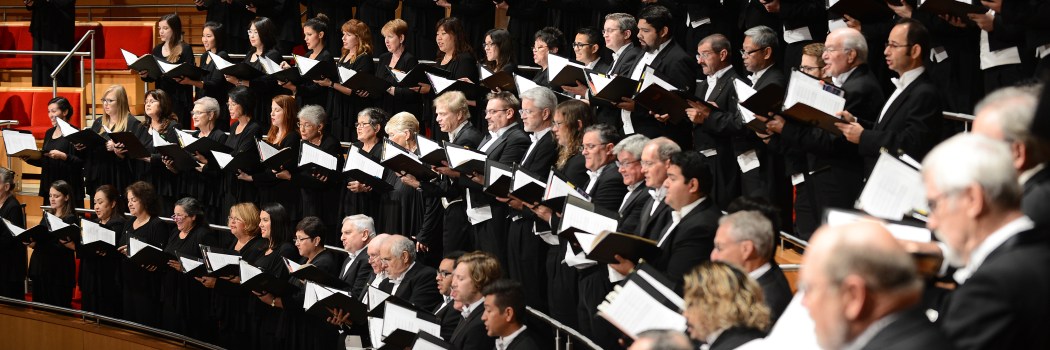
An Interview with Robert Istad, Pacific Chorale’s Artistic Director
When Carl St.Clair and Pacific Symphony navigate their way through the dramatic terrain of Verdi’s Requiem June 5-8, they’ll be doing so with their long-time vocal partners, Pacific Chorale. Dr. Rob Istad, currently enjoying his eighth season at the Chorale’s helm, recently took some time to discuss his approach to the work: what it means to him, and how he prepares his singers.

“I love this piece, especially because of its history,” Istad says. “Verdi himself was such a champion of the unification of Italy, and of Italian art forms, the nationalistic perspective. It’s meaningful to me, and also I love his operas. Carl and I have had so many great experiences with Verdi’s operas. I’ve prepared every opera for Carl since Symphonic Voices started. I find the Requiem to be deeply human. It’s obviously very dramatic. Conductor Hans von Bulow said it was nothing but opera in church dress, and that was pejorative, but Brahms thought it was genius–and he didn’t like anything. I think it’s a deeply human approach to death and the afterlife, whether Verdi was a deist or atheist.
“The first part gives us the deeply Catholic tradition of praying someone to heaven, then we have a first-person narrative of someone looking at their soul, then a heavenly perspective with the “Sanctus.” The “Libera me” is a deeply human expression of worry and terror about death, of uncertainty. He’s leaving us with this question, maybe sharing his perspective of God and death–maybe questioning, sharing his own worries.
“And I find it really relatable. It’s connected with spirituality and doubt, it’s all-embracing. He captures our dreams, fears, worries, and hopes. Ultimately, I love it because it’s such a beautiful vocal piece. Singers love to sing it, and the kind of soloist you need is a once-in-a-lifetime voice. The singers you hire to do Verdi’s Requiem are not the ones you hire to sing Mozart’s Requiem.”
As for getting the Chorale ready to manage this sacred beast, Istad says a lot of the work was already done before his arrival.

“The amazing thing about the Chorale is that the organization has matured so much artistically over the last 25 years. The chorus is so facile. They’re excellent musicians, wonderful singers. The Verdi requires flexibility and resonance, and the singers engaged for that performance are attuned to that kind of singing. The level of musicianship and singing is just blossoming. I do have the whole score printed on my heart and (brain), but regardless of how many times I’ve done it, I learn and relearn and erase and change ideas. I don’t have to teach them how to sing; they know how to sing. But for half the Chorale, this is their first time singing the work. It’s so much fun to introduce them to this piece, and I know they’ll fall in love with it.”
Istad also has intimate knowledge of St.Clair’s vision for the work.
“I also prepare knowing what Carl likes to do with the piece. Carl believes in the rhythmic intensity of Verdi and allows the rhythm to inform the melodic and harmonic content. It’s so rhythmically vital and exciting. When I prepare this for Carl, I’m attuned to the percussive rhythm and forward momentum. He always tells me he wants the Chorale always moving forward, never stepping backward. And he works with such respect for the singers. A choir that feels loved and appreciated performs far differently than one that feels the other way. Your voice is so connected to your spirit and soul and who you are as a human, and he honors that. That’s how he gets these special performances. He gives singers permission to be themselves.
Istad said that he’s always aware of the legacy of his predecessor during performances. “I always try to honor my mentor, John Alexander. That man taught me how to prepare a choir. He’s the master of doing that, and he shared his knowledge and experience with me. I’ve sung it with him, I’ve studied it with him. He’s the person that inspired me to do this. Preparing a work for another conductor is another art form all on its own, and you need a mentor to do it well.”
There are four chances to experience this great work: Thursday-Saturday, June 5-7 as an evening concert and once more as a matinee on Sunday, June 8. Led by Carl St.Clair in his last concert as Music Director at the Renée and Henry Segerstrom Concert Hall in Costa Mesa, Pacific Symphony will also be joined by four soloists and Pacific Chorale. Get your tickets today!
You can listen to the Requiem before experiencing it live below.
