
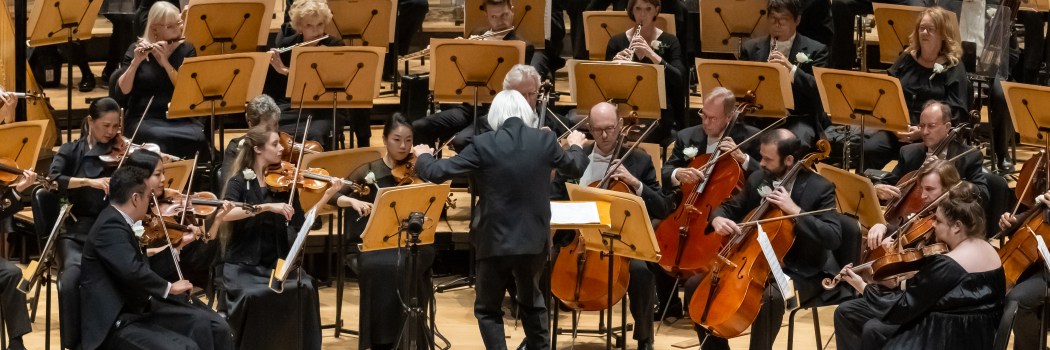
Bruckner, Symphony No. 7
Is it wrong to wish Anton Bruckner had been a little more stubborn?
Certainly it would have simplified the work of identifying the definitive performance scores for his symphonies if he’d just said, “Close enough” and moved on. As it stands, his catalog is unique in its number of contrasting editions, reflecting a tortured history of attempts to clarify and re-clarify.

Many explanations by armchair psychologists have been offered regarding Bruckner’s constant tinkering: susceptibility to well-intentioned but ambitious collaborators, a desire to be embraced by a critical and indifferent public, insecurity due to his late start as a composer (he was 40 when he completed his first large-scale work).
Yet with so many internal and external forces arrayed against him, so much confusion surrounding his work, and so many wounds (self-inflicted and otherwise), his compositions remain fixed in the canon. Recorded and re-recorded, revisited, enshrined, cherished. Detours and all, Bruckner still holds his reputation as one of the greatest of symphonists, an innovator whose musical intellect and perpetual search for the transcendent has had a profound impact on generations of listeners.
Regardless of the motivation, he had a mania for revision, a tendency that showed itself as early as 1873 with his second symphony, revised substantially after the premiere at the urging of his champion, Johann Herbeck. From that point forward, the door was open, and a dismal record of indifference or rejection from audiences and critics only made matters worse.
This is one of the central puzzles presented to us by the composer, as described by musicologist Deryck Cooke in his landmark 1969 article “The Bruckner Problem Simplified”: “By 1903, there were in existence no less than 25 different scores of the nine symphonies,” says Cooke. “Moreover, the 10 published ones did not represent Bruckner’s own intentions, whereas the 15 unpublished ones were either authentic or at least nearly so.”
Since Cooke’s article, more scholarship has emerged, and our image of a timid, compliant man eagerly accepting composing tips from all and sundry has largely been demythologized. (Said Dermot Gault in The New Bruckner (2011): “We cannot rely on anything Deryck Cooke … has to say on the subject of Bruckner versions or editions.”) We can’t ignore the many editions, but we may have a greater understanding of the impulses behind them. At the risk of simplification, later historians see the early published versions as Bruckner’s intended statements at the time, and later versions as an advanced phase in the creative process.
But what a creative process.
Revisions notwithstanding, Bruckner enjoyed the greatest success of his career with the Seventh Symphony, a surprise to him late in life, considering the brickbats that had been hurled his way. (Consider that he never heard his Fifth or Sixth symphonies performed in their complete versions.) The seventh was no exception to the composer’s incessant tinkering. He “finished” it in 1883 and revised it in 1885, and there are now several versions floating around. But mechanics aside, the work carries Bruckner’s hallmark profundity. His compositional process leapt away from the genre’s formal structures, the Best Practices of the sonata form, the methodical argumentation to a final point, that one hears in the recognized masters of the Classical Era, and we are in some sense unmoored. Or rather, ever present. As Cooke says, “with Bruckner firm in his religious faith, the music has no need to go anywhere, no need to find a point of arrival, because it is already there…Experiencing Bruckner’s symphonic music is more like walking around a cathedral, and taking in each aspect of it, than like setting out on a journey to some hoped-for goal.”
Don’t miss Bruckner’s Seventh Symphony during Pacific Symphony’s Cathedrals of Sound concert, May 15-17 this week. The evening is complete with Gregorian Chant featuring the Norbertine Fathers of St. Michael’s Abbey, Bach’s Air from Suite No. 3 in D Major for Orchestra with Concertmaster Dennis Kim, and Guilmant’s First Symphony for Organ and Orchestra with Paul Jacobs. There’s still time to join us!
You can learn more about the concert in the pre-recorded preview talk with KUSC Midday Host Alan Chapman below.

