
THE STORY BEHIND THE MUSIC: The White Peacock
When Cabaret’s Sally Bowles utters those words, flaunting her emerald-green fingernails, she’s in Berlin, where Charles Tomlinson Griffes was inspired to compose The White Peacock. Though Cabaret takes place in 1931, 16 years after Griffes completed the piano version of this lustrous tone-poem, her three-word assertion of personal style sums up an esthetic philosophy that deeply influenced him. In fact, it extended from the late 19th Century through the years just preceding World War II. We see it in Art Nouveau style and hear it in the lushness of musical Impressionism.

With Nazism taking rise around her, Sally struts her stuff with defiantly cheerful glibness. By that time, European artists and composers had been styling like Sally for decades—using exaggerated, outré recasting of elements from nature to push back against the terrifying changes that came with Europe’s unraveling political structure and the emergence of industrialization. To many, it seemed that civilization and nature were ending, as Yeats wrote in his 1919 poem The Second Coming: “Things fall apart; the centre cannot hold; / Mere anarchy is loosed upon the world…”
The brilliance of Art Nouveau style and the steamy sensuality of composers such as Griffes were partly a backlash against the horrors Yeats foretold. This is why we see an intensified reassertion of nature within the cityscape in architectural confections such as Hector Guimard’s Paris Métro entrances and Antoni Gaudi’s Sagrada Familia cathedral in Barcelona, with their biomorphic forms that give iron and stone the supple drape of a flower. In the graphic arts of the period, scrollwork, archways, sunbursts and women’s flowing tresses take on dreamlike intensity.
Griffes was well aware of the importance of peacocks as an example of nature’s effulgent beauty in illustrations by Beardsley and Erté, and after seeing a white peacock at the Berlin zoo, he casually cited a poem by William Sharp as the literary inspiration for his 1915 tone poem. But there can be no doubt that he also reflected on the white peacock as a symbol of decadence when composing it. Richard Strauss’s 1906 opera Salome was still an international sensation in 1915, and in both the opera libretto and the Oscar Wilde play on which it is based, Herod’s attempt to bribe Salome with fifty white peacocks is of crucial importance. He describes them in terms that are vividly sensuous, but corrupt. “Salomé,” he begs, “you know my white peacocks, my beautiful white peacocks that walk in the garden between the myrtles and the tall cypress trees. Their beaks are gilded with gold, and the grains that they eat are gilded with gold also, and their feet are stained with purple. When they cry out the rain comes, and the moon shows herself in the heavens when they spread their tails. I will give you 50 of my peacocks. They will follow you whithersoever you go, and in the midst of them you will be like the moon in the midst of a great white cloud.”
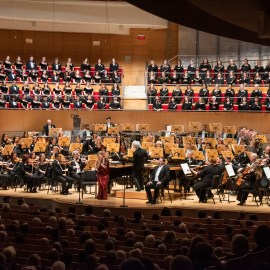
Beautiful, but creepy. Enjoy the divine decadence of Charles Griffes’ The White Peacock when Pacific Symphony performs the work under the baton of Guest Conductor Andrew Litton (Feb. 22-24)!
Pacific Symphony’s Beethoven & Shostakovich’s concert is the seventh concert of the 2023-24 Hal and Jeanette Segerstrom Family Foundation Classical Series. 2023-24 Classical Season sponsors include the Park Club California, PBS SoCal, and Classical California KUSC.