
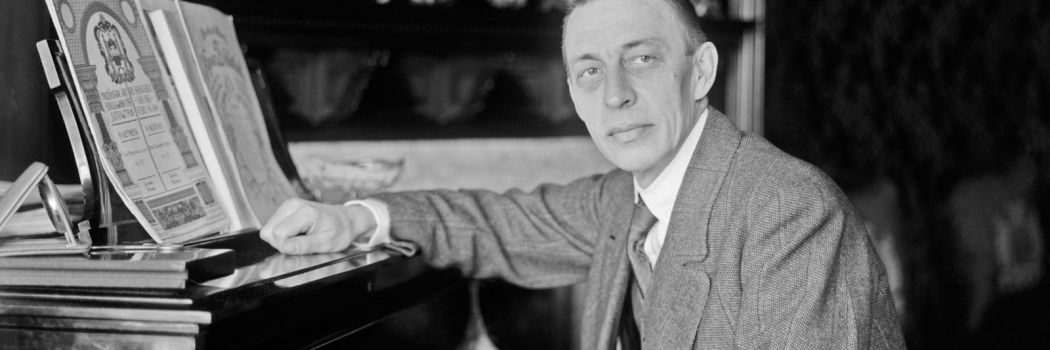
A massive case of writer’s block finally smashed to bits.
RACHMANINOFF: Piano Concerto No. 2 in C minor, Op. 18
Rachmaninoff’s celebrated Second Piano Concerto starts with one of the most dramatic and emotionally fraught moments in classical musIc: the pianist gradually brings the work to life with chords that increase in volume and dissonance until, after an almost unbearable climax, the orchestra comes in to resolve the tension with a theme that seems quintessentially Russian. What was the story behind that moment?
What you’re hearing is the sound of a massive case of writer’s block finally being smashed to bits. The young composer suffered through one of the worst dry spells in his career before finally finishing the work.
The premiere of Rachmaninoff’s First Symphony in 1897 was a complete disaster, the result of a poor, underrehearsed performance led by conductor Alexander Glazunov, who many suspected was drunk at the podium. Rachmaninoff suffered a deep depression that prevented him from composing for three years. He started drinking heavily.

In 1899, he was supposed to perform the Second Piano Concerto in London, but he hadn’t composed it by the date of the performance. He was forced instead to make his conducting debut, which was fortunately successful. That led to an invitation to return to London the following year with his First Piano Concerto, which he had composed in 1891 when he was a teen. Feeling newly confident in the afterglow of the concert, he promised to perform his new piano concerto instead.
But Rachmaninoff’s creative block continued, and he resorted to desperate measures to end it. He consulted with Leo Tolstoy, the undisputed king of Russian culture, but that didn’t solve the problem. Finally, his family persuaded the young rising star to visit the renowned neurologist Nikolai Dahl, who worked with him from January to April 1900. Dahl, who was a trained musician himself, used hypnosis and lengthy, deep conversations about creativity to bring Rachmaninoffout of his funk. He would frequently repeat a mantra to the composer after lulling him into drowsiness: “You will begin to write your concerto … You will work with great facility … The concerto will be of an excellent quality.”
Dahl succeeded where Tolstoy failed. Rachmaninoff dedicated the concerto to the famous therapist for successfully treating him by restoring his health and self-confidence.
The concerto was given its premiere by the Moscow Philharmonic Society in November 1901, with the composer, also one of the great piano virtuosos of his day, performing the devilishly tricky solo part. Despite some misgivings about the first movement, which was composed last, Rachmaninoff was ultimately pleased with the result—especially after receiving ecstatic reviews. Even composer Cesar Cui, who had savaged Rachmaninoff’s First Symphony, was an enthusiastic fan.
The popularity of the Second Piano Concerto grew rapidly over the next few years, and it has remained one of the most frequently performed piano concertos in the repertoire ever since. Now that’s the way to end writer’s block!
Experience the concerto performed live by Alessio Bax on Opening Weekend: Rachmaninoff & Sibelius, September 19-20, 2026. Ludovic Morlot guest conducts Pacific Symphony. Get your tickets today!