
Richard Strauss: An Alpine Symphony
The history of the symphony orchestra is all about growth. As composers’ ideas and demands became bigger and more complex, so did the number and type of instruments required to bring them to life.
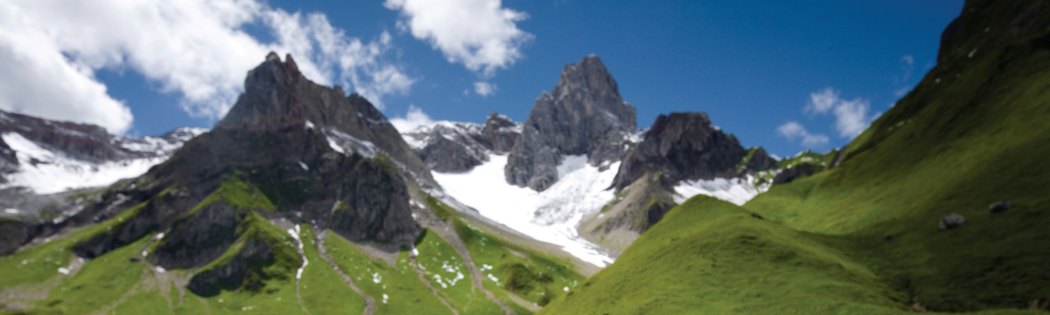
Richard Strauss’ tone poem, An Alpine Symphony, is the perfect example of orchestral gigantism. The score calls for about 125 players, which seems about right when you consider the composer’s intent: to recreate in music what it’s like to climb an Alpine mountain, from daybreak to nightfall.

Strauss (1864-1949) is considered a master of the Late Romantic German school. Like Wagner and Mahler, he reached for the stars, philosophically and musically. He said this symphony “represents moral purification through one’s own strength, liberation through work, worship of eternal, magnificent nature.” For those lofty goals, nothing less than climbing a mountain would suffice, with a diverse entourage of musicians in tow. It was the last of Strauss’ nine tone poems. After that, he turned his attention to opera.
An Alpine Symphony took four years to compose, although some of its ideas started forming around 1899. Strauss first called it “Tragedy of an Artist,” a reference to the suicide of Swiss-born painter Karl Stauffer-Bern. After several changes of direction and frequent stops and starts, it made its debut in 1915 with the Dresden Court orchestra in Berlin, conducted by the composer.
Because of the massive resources the work demands, it isn’t frequently programmed. The long list of required instruments includes a wind machine, cowbells, two sets of timpani, an organ, and up to 20 horns. “You see, I have finally learned how to orchestrate,” Strauss joked at the final rehearsal before the symphony’s premiere.
Strauss was a lifelong hiker and nature lover. At this point in his career, he spent part of each year in the southern Bavarian town of Garmisch, close to Germany’s tallest mountain, Zugspitze. Even in middle age he took regular mountain rambles. An Alpine Symphony springs from intimate familiarity with its subject.
The score’s 22 blended movements are descriptively titled to tip us off about the climber’s location: “Wandering by the Brook,” “At the Waterfall,” “On the Glacier.” An intense movement called “Thunder and Tempest, Descent” is based on the composer’s own scary alpine encounter with bad weather as a 14-year-old. Strauss recalled that after that cathartic experience, “The next day I portrayed the whole thing on the piano.” Not surprisingly, “Thunder and Tempest” uses the biggest orchestration of the entire symphony.
Like Vivaldi before him, Strauss pushed against the constricting rules of composition that dictated classical music. “I have found myself in a gradually, ever-increasing contradiction between the musical-poetic content that I want to convey and the ternary sonata form that has come down to us from classical composers,” he wrote. “I consider it a legitimate artistic method to create a correspondingly new form for every subject.”

Musicians are sometimes a bit intimidated by the sheer technical demands of pulling off Strauss’ musical three-ring circus. It’s a beast to bring it all together. “There is something in it that appears decadent, over the top,” said French conductor Emmanuel Villaume. “If there was a kitchen sink on the summit, it would be there.”
But if all the countless elements come together, the effect is unlike anything else in the orchestral literature. Audiences of the time were fascinated. So were orchestras. There was a fight between Cincinnati and Philadelphia to secure the American premiere. Ernst Kunwald led the Cincinnati Symphony Orchestra in a sold-out performance on April 27, 1916, one day before its Philadelphia debut. More than 2,000 people came to hear it.
An Alpine Symphony brought the late Romantic era to an end. World War I was already raging, and European orchestras were soon decimated. Curiously, Strauss’ work bears no hint of the horrors of war unfolding as it was finished. Strauss was hyper-focused on telling a detailed story about a dramatic landscape through music. Perhaps its grandness and beauty helped audiences to forget, if only for a while, what was happening in the world.
Pacific Symphony will be performing An Alpine Symphony on two programs in January.
Four Seasons & Strauss, Jan. 9-11, 2025 at 8 p.m.
A Day in the Alps, Jan. 12, 2025 at 3 p.m.
You can also listen a recording of the entire piece by the Berliner Philharmoniker in the playlist below.