
Saint-Saëns’s Carnival of the Animals is a Party, and You’re Invited. Bring the Kids!
Talking about great classical music that’s family-friendly? You have to talk about The Carnival of the Animals. Almost a 140 years after Camille Saint-Saëns composed his Le Carnival des animaux, it’s astonishing to note that this appealing, colorful work—one of the composer’s most popular—nearly died with him. Saint-Saëns was one of classical music’s most accomplished scene-painters; the animal caricatures in this glorious carnival are astonishingly vivid and often hilarious, delighting children and grownups in equal measure. After hearing The Carnival of the Animals, watching animals in the zoo or tropical fish in your home aquarium will seem very different and much more fun.

It’s instructive to compare this suite to an equally familiar work from the Great American Songbook: Broadway composer Frank Loesser’s sophisticated standard “Baby It’s Cold Outside.” Though they inhabited very different musical worlds, Frank Loesser and Camille Saint-Saëns were both revered as versatile musical geniuses by their colleagues. Loesser gave us the words and lyrics for the classic musical Guys and Dolls and the nearly operatic Most Happy Fella, but the strange history of his song “Baby It’s Cold Outside” closely resembles that of Le Carnival des animaux. Both were composed as private entertainments to be performed exclusively for friends. As both works became unexpectedly popular—the respective equivalents of “going viral”—their composers resisted pressures to capitalize on their success by publishing. Saint-Saëns held out, while Loesser did not. But in the end, it didn’t make much difference; both works entered the standard repertory and are now widely programmed and enjoyed.
Loesser composed “Baby It’s Cold Outside” as a party piece that became a calling card for him and his first wife, the club singer Lynn Garland. “We got invited to all the best parties for years on the basis of ‘Baby,’ ” said Garland. “It was our ticket to caviar and truffles. Parties were built around our being the closing act.” Similarly, Saint-Saëns composed Le Carnival as a sophisticated, light entertainment for private performance after his disastrous concert tour of Germany in 1885 and 1886. He had already begun work on his ambitious and serious Symphony No. 3, the “Organ” symphony, and confessed to feelings of guilt for putting it on hold. But clearly, some therapeutic diversion was in order.
Saint-Saëns withdrew to a quiet Austrian village and began composing the 14-part suite in February 1886. From the beginning, he considered Le Carnival as innocent, lighthearted fun. But it soon acquired a following of distinguished admirers who took it for more than that—first at a private concert hosted by the cellist Charles Lebouc, and then at a similar musicale at the home of the legendary mezzo-soprano Pauline Viardot with Franz Liszt in attendance.
When Loesser finally relented and sold “Baby It’s Cold Outside” for publication—it was first recorded in Hollywood for the Esther Williams vehicle Neptune’s Daughter—Lynn Garland confessed to feeling “as betrayed as if I’d caught him in bed with another woman.” Saint-Saëns stood fast in barring publication of Le Carnival during his lifetime, but it was rushed into print less than a year after his death.
The Carnival is actually a succession of witty movements introduced with a two-piano statement that is somehow portentous, stately, and ungainly all at once. Scales diverge, then reconverge. We are put off balance and put on notice: Something dramatic and strange is coming. But what? In a word, fun—in the form of 14 movements that parade before our ears and seemingly before our eyes.

There are always more musical jokes to be discovered in Le Carnival des animaux. But this music rises above mere amusement, and its humor does not diminish its descriptive powers, which make us gasp as well as laugh. No composer excelled Saint-Saëns in the creation of vivid atmosphere and, in this case, mimicry. The wit is in their selection as well as their uncanny accuracy of aural description. We all have our favorites: the otherworldly aquarium for anyone who has ever owned or seen one; the doleful solitary cuckoo in the woods, for anyone who has ever heard one. Personnages á longues oreilles, or characters with long ears, are braying donkeys. Or are they braying music critics? But neither does Saint-Saëns spare himself and his colleagues: the Pianistes movement depicts pianists at their interminable scales.
The most famous movement of the Carnival is number XIII, “Le cygnet” (“The Swan”), a moment of poetry that comes just before the raucous finale. This purling cello solo, with its extended legato phrases, was immediately co-opted as a separate concert work, and was the sole movement of the Carnival that Saint-Saëns consented to publish during his lifetime. (To resist would have been like trying to push back the tide.) With this movement as musical accompaniment, the Russian prima ballerina Anna Pavlova moved audiences to tears in one of the most celebrated dance interpretations of the 20th century, “The Dying Swan.”
A Trivia Enthusiast’s Guide to The Carnival of the Animals
The Carnival of the Animals is an almost endless source of musical trivia. Here are some examples:
- What is an undectet? Or a hendectet?
These synonymous terms denote an 11-piece musical ensemble — such as Carnival, which was initially composed for two pianos, xylophone, flute/piccolo, clarinet, glass harmonica, two violins, viola, cello, and double-bass.
What is a glass harmonica? With its weird, ghostly sound, this fragile instrument resembles an array of wine goblets in graduated sizes. It was a rarity even in 1886, when Saint-Saëns scored it in Carnival. In modern performances it is usually replaced by the celesta.
Ready for a musical treasure-hunt?
As musical satire, Carnival is full of comic musical quotations. They’re all turned topsy-turvy—fast becomes slow, high becomes low, etcetera. In addition to Saint-Saëns’s own Danse Macabre, there’s Rossini’s Barber of Seville, Gounod’s Faust, Mendelssohn’s A Midsummer Night’s Dream, and Offenbach’s Orpheus in the Underworld. Chopin is there, too, along with “Twinkle, Twinkle, Little Star.” Can you find more?
Name that versifier!
Not surprisingly, Carnival has been catnip for satirical poets, who love to pair their clever rhymes with Saint-Saëns’s musical descriptions. “Weird Al” Yankovic and the late Professor Peter Schickele (aka PDQ Bach) are among those that have penned poetic accompaniments. But the most famous version remains that of Ogden Nash, who wrote his for a 1950 recording by Andre Kostelanetz and the Hollywood Bowl Orchestra narrated by Noel Coward.
Here’s your intrepid annotator’s favorite verse from the Nash suite:- The swan can swim while sitting down.
- For sheer conceit he takes the crown.
- He looks in the mirror over and over,
- And claims to have never heard of Pavlova.
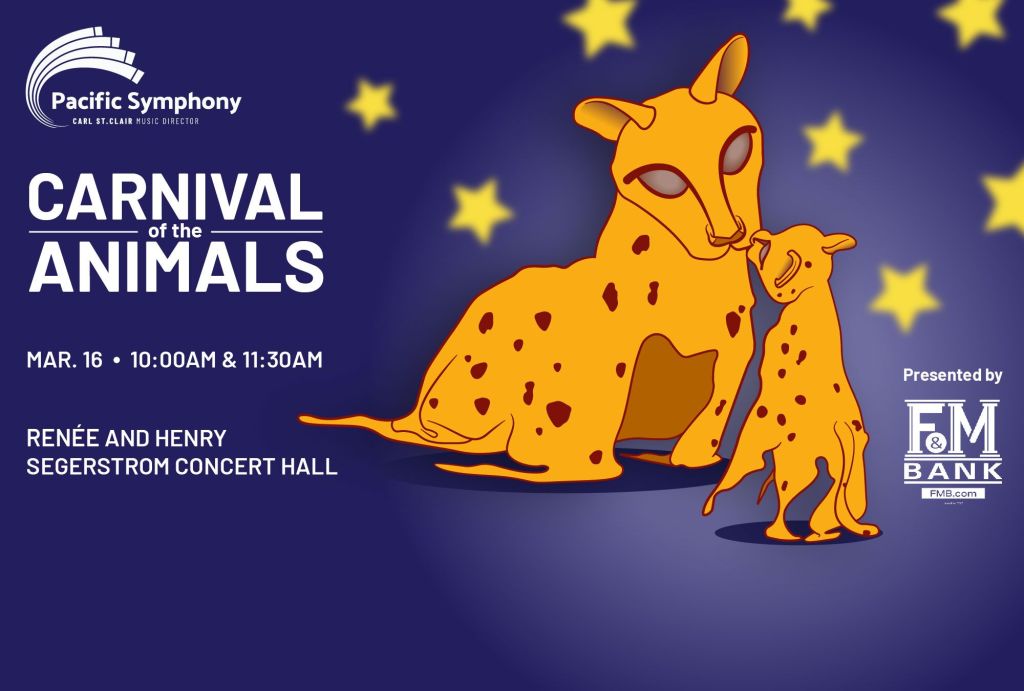
Carnival of the Animals is the fourth concert of the 2023-24 Family Musical Mornings Series presented by Farmers & Merchants Bank. The concert opens with Hector Berlioz’s Roman Carnival Overture and features the work of Puppet Artist Robin Walsh. To learn more about the 10 a.m. and 11:30 a.m. Saturday, Mar. 16 concert and get tickets, please click here.
Michael Clive is a cultural reporter living in the Litchfield Hills of Connecticut. He is program annotator for Pacific Symphony and Louisiana Philharmonic, editor-in-chief for The Santa Fe Opera and editor of OperaHound.com.